Six steps, one surface.
A microcement job is built up in layers, each left to dry before the next. Times below are from NZ installers and suppliers; your system’s data sheet governs.
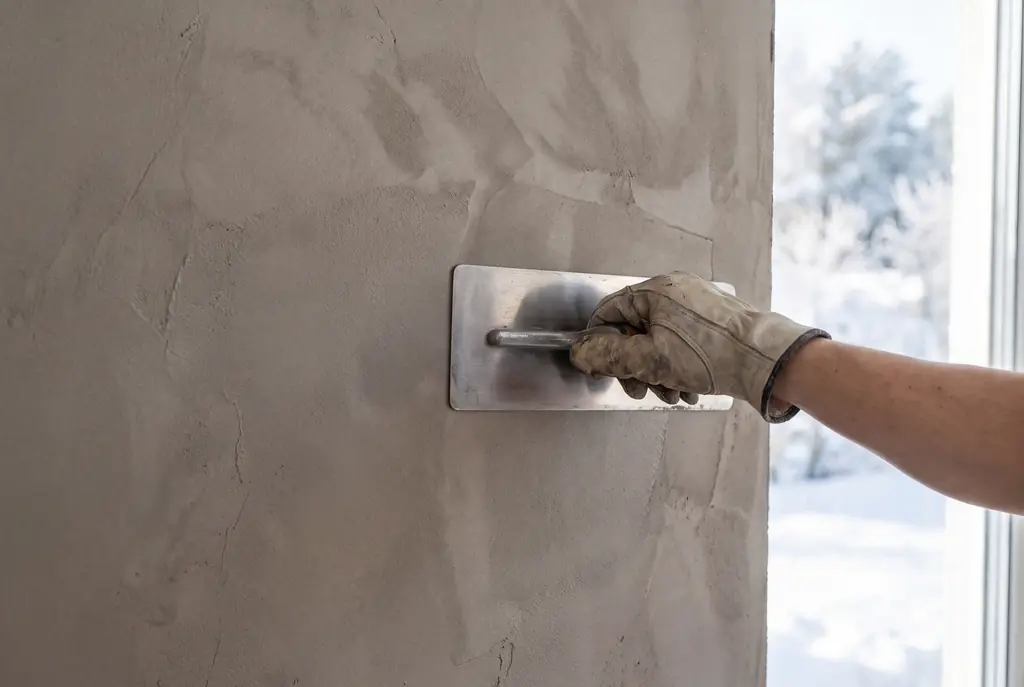
- Step 01
Survey and brief
Moisture readings, movement, what is already on the surface and what the room will be asked to do. Tiles, vinyl and old paint each change what the base needs.
- Step 02
Prepare and prime
The surface is flattened, repaired and primed. Every hollow and old tile line shows through three millimetres of finish, so the preparation is most of the job.8
- Step 03
Mesh and base coats
Primer or bonding bridge with glass-fibre mesh, then two coarser base coats for strength and adhesion.8
- Step 04
Finish coats
Two finer coats, trowelled by hand. The texture comes from the trowel, not from a pattern.8
- Step 05
Sand and seal
After the finish has dried (typically 24–48 hours), it is sanded and sealed, usually in two coats. The sealer is what turns a coating into a working surface.8
- Step 06
Cure and care
Installation can take up to seven days, and the surface takes around 30 days to fully harden. Be careful not to drop or drag things across it in the first month.10
What people ask first.
Short answers, with sources. If a claim is a supplier’s, it says so.
What does microcement cost in New Zealand?
There is no single price per square metre, and we did not find reliable Queenstown or floor pricing, so this page shows none. One Auckland applicator publishes indicative 2026 ranges, including GST, for properly prepared interior walls: about NZ$215–$280 per m² for a polished, concrete-look plaster finish, and from about NZ$120–$180 per m² for lighter textured finishes, with a minimum job of around NZ$1,500. 9
Floors, bathrooms and wet areas are quoted individually, because preparation, waterproofing and sealing add cost. 9, 8 As a materials-only reference, one NZ distributor lists TechSol microcement at NZ$320 plus GST per 15 kg tub. 6 Treat all of this as a rough guide and get written quotes.
Can I do it myself?
Is microcement waterproof?
Treat it as water-resistant once sealed. One NZ system describes itself as waterproof throughout its layers before sealers, which is a manufacturer claim that should come with evidence. 3 In any case, microcement and its sealer are not a substitute for a waterproofing membrane where one is required. 8, 12
Can it go over my existing tiles?
Does it work with underfloor heating?
Widely, yes, provided the screed is cured, commissioned and moisture-tested first, the system uses fibreglass mesh, and the heat is brought up slowly after the sealer has cured. See the ramp diagram. 2, 21
Can it go outside?
How do I look after it?
Routine cleaning with a suitable neutral detergent is generally enough, and the sealer is what protects the surface. Some systems have maintenance waxes or periodic resealing. 8
Will I need a building consent?
It depends on the work. Wet-area surfaces must meet clause E3, and a microcement floor in a wet area is outside E3/AS1’s listed floor finishes, so compliance has to be shown as an Alternative Solution. Whether a building consent is needed depends on the job, so ask your council before you start: Queenstown Lakes District Council covers Queenstown and Wānaka, and Central Otago District Council covers Cromwell and Alexandra. This page is not building advice.
How is it different from polished concrete?
Polished concrete is the local default for a seamless floor, and E3/AS1 lists a steel-trowelled or polished slab as an acceptable wet-area floor. 11 It is the slab itself, ground and sealed. Microcement is a thin coating added over a sound surface, so it can go over existing tiles or walls and into colours the slab will never be. The trade-off is that its wet-area compliance is shown as an Alternative Solution, not by the Acceptable Solution.
Can it be repaired, and when does it need resealing?
Systems differ, and we found no NZ manufacturer data to quote here. Ask the manufacturer for its recommended resealing interval in writing, and ask the installer how a local repair is blended: matching tone across a hand-trowelled surface is skilled work.
Planning a quiet room?
Tell us about the room, the surface underneath and the finish you are drawn to.